
Table of Contents
If you’ve ever unlocked your phone with your face, received eerily accurate Netflix recommendations, or seen Gmail filter spam before you even noticed it — you’ve interacted with machine learning.
But what is machine learning, really?
Not the buzzword version.
Not the hype.
The actual mechanism.
Machine learning is not magic. It’s not intelligence in the human sense. And it’s not a single algorithm running somewhere in the cloud.
It’s a disciplined way of teaching systems to recognize patterns from data — and then use those patterns to make decisions.
In this guide, we’ll break down what is machine learning in a way that’s practical, structured, and deeply clear. No fluff. Just fundamentals, intuition, and real-world examples.
What Is Machine Learning?
At its core:
Machine learning is a method of building systems that learn patterns from data instead of being explicitly programmed with rules.
In traditional programming, you write rules.
In machine learning, you provide data — and the system discovers the rules.
Think of it this way:
- Traditional programming = You write the recipe.
- Machine learning = You show examples of dishes, and the system figures out the recipe.
This shift changes everything.
Instead of telling a computer:
“If email contains X, Y, and Z words, mark it as spam.”
You say:
“Here are 10,000 spam emails and 10,000 normal emails. Learn the difference.”
And it does.
That’s the foundation of machine learning explained in simple terms.
Why Machine Learning Exists
Traditional programming works well when:
- Rules are clear.
- Edge cases are minimal.
- The problem is structured.
But what about:
- Recognizing faces?
- Translating languages?
- Predicting stock movements?
- Diagnosing diseases from images?
You can’t manually write rules for every possible pixel combination in a face.
The complexity explodes.
Machine learning exists because real-world data is messy, ambiguous, and dynamic.
It allows systems to adapt.
How Machine Learning Works (Step-by-Step)
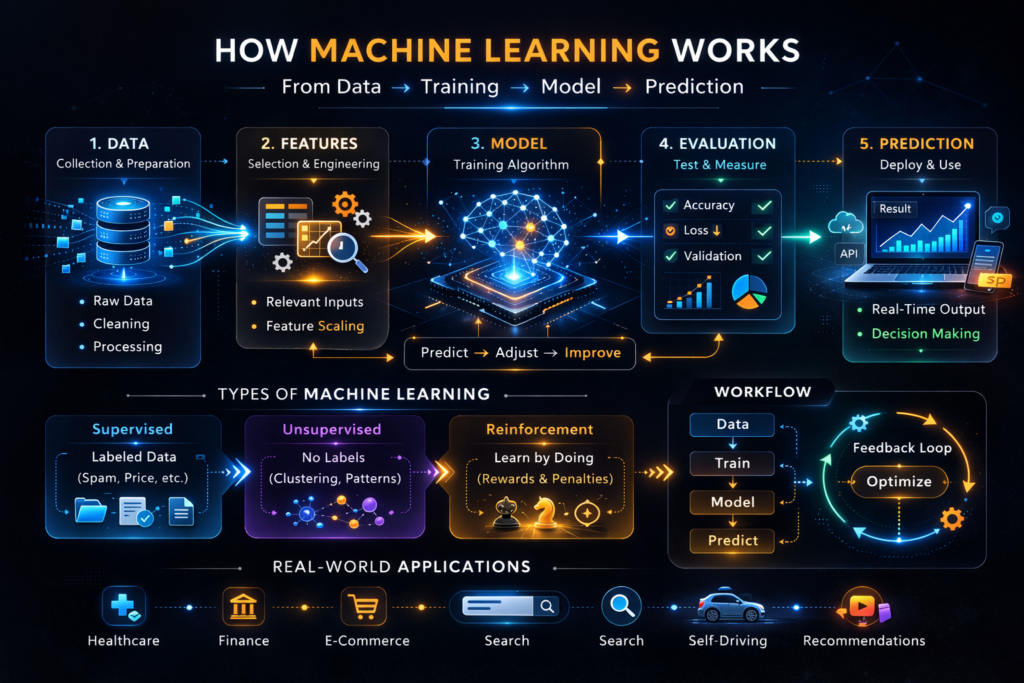
Let’s break down how a typical machine learning system is built.
Step 1: Data Collection
Everything starts with data.
Examples:
- Images of cats and dogs
- Customer transaction records
- Historical house prices
- User behavior logs
The quality of your data determines the quality of your model. Garbage in, garbage out.
Step 2: Data Preparation
Raw data is rarely usable.
You clean it:
- Remove duplicates
- Handle missing values
- Normalize numerical values
- Encode categories
This step often takes 60–80% of the total effort in real ML projects.
Step 3: Feature Engineering
Features are measurable properties of the data.
For house price prediction:
- Area
- Number of rooms
- Location
- Age of house
Better features → better learning.
Step 4: Model Selection
You choose an algorithm.
Examples:
- Linear Regression
- Decision Trees
- Neural Networks
- Support Vector Machines
Each has strengths and trade-offs.
Step 5: Training
The algorithm looks at the data and adjusts internal parameters to minimize error.
Think of it as iterative correction.
It predicts → measures error → adjusts → repeats.
This is optimization.
Step 6: Evaluation
You test it on unseen data.
Common metrics:
- Accuracy
- Precision
- Recall
- Mean Squared Error
If performance is poor → backtrack → adjust features or model.
Step 7: Deployment
Once validated, the model is deployed into real-world systems:
- Apps
- Websites
- APIs
- Embedded devices
And it continues learning or updating periodically.
Types of Machine Learning
When people ask what is machine learning, they often mean: “What kinds are there?”
There are three core types.
1. Supervised Learning
This is the most common type.
You provide:
- Input data
- Correct output labels
The model learns mapping from input → output.
Examples of Supervised Learning
- Email spam detection
- House price prediction
- Medical diagnosis classification
- Credit scoring
Two major subtypes:
Classification
Output = category
Example: Spam or Not Spam
Regression
Output = continuous number
Example: Predicting temperature
Supervised learning is like learning with an answer key.
2. Unsupervised Learning
No labels.
The model finds structure on its own.
It answers questions like:
- What groups naturally exist?
- Are there hidden patterns?
- Which data points are unusual?
Examples of Unsupervised Learning
- Customer segmentation
- Market basket analysis
- Fraud detection
- Topic modeling
Common techniques:
- K-Means Clustering
- Hierarchical Clustering
- PCA (Dimensionality Reduction)
This is discovery-driven learning.
3. Reinforcement Learning
This is learning through interaction.
The system:
- Takes action
- Receives reward or penalty
- Adjusts behavior
It’s trial-and-error optimization.
Real-World Examples
- Self-driving cars
- Game-playing AI
- Robotics
- Ad bidding systems
A famous example:
DeepMind used reinforcement learning to train AlphaGo, which defeated world champion Lee Sedol in Go — a game once thought too complex for machines.
Reinforcement learning mimics behavioral learning in animals.
Machine Learning vs Traditional Programming
Let’s clarify this with a direct comparison.
| Aspect | Traditional Programming | Machine Learning |
|---|---|---|
| Rules | Manually written | Learned from data |
| Adaptability | Low | High |
| Data Dependency | Moderate | Very High |
| Performance on Complex Patterns | Limited | Strong |
| Transparency | High | Sometimes Low |
Traditional programming:
Input + Rules → Output
Machine learning:
Input + Output → Rules (learned model)
That inversion is the breakthrough.
Real-World Machine Learning Examples
Understanding what is machine learning becomes easier when you see it in action.
Let’s explore practical cases.
Recommendation Systems (Netflix & Amazon)
Netflix uses machine learning to analyze:
- Viewing history
- Watch time
- User ratings
- Similar user behavior
It predicts what you’ll enjoy next.
Similarly, Amazon uses ML for product recommendations and demand forecasting.
These systems increase engagement and revenue dramatically.
Healthcare Diagnostics
Hospitals use ML to:
- Detect tumors in MRI scans
- Predict patient deterioration
- Personalize treatment plans
A study showed deep learning models matching or exceeding radiologists in certain image recognition tasks.
This isn’t replacing doctors.
It’s augmenting them.
Fraud Detection
Banks use ML to detect unusual transaction patterns.
If:
- You normally spend ₹500–₹2000
- Suddenly there’s a ₹1,20,000 international transaction
The model flags it instantly.
Traditional rules would miss evolving fraud patterns.
ML adapts continuously.
Search Engines
Google uses machine learning in ranking algorithms, language understanding, and query interpretation.
Search results are not static rule-based lists.
They’re dynamic predictions.
Deep Dive: What Is Machine Learning in Practice?
Let’s take a mini case study.
Case Study: Predicting House Prices
Problem:
Predict price based on features.
Data:
- 10,000 houses
- Area, bedrooms, location, age
- Known selling prices
Step 1: Choose Model
Start with Linear Regression.
Step 2: Train Model
Minimize error between predicted and actual prices.
Step 3: Evaluate
Mean Absolute Error = ₹1.8 lakh.
Step 4: Improve
Add new features:
- Distance to metro
- School ratings
Error reduces to ₹1.2 lakh.
This is iterative refinement.
Machine learning isn’t about perfection.
It’s about optimization.
Tools to Start Learning Machine Learning
For strong theoretical foundations, Stanford University’s CS229 Machine Learning course provides one of the most rigorous academic introductions to machine learning
If you’re serious about going beyond “machine learning explained” and actually building systems:
Programming Languages
- Python (dominant ecosystem)
- R (statistical focus)
Libraries
- Scikit-learn
- TensorFlow
- PyTorch
- XGBoost
Learning Platforms
Stanford University offers foundational ML courses.
Google provides a free ML Crash Course.
Start simple. Build projects. Iterate.
Common Mistakes Beginners Make
1. Jumping to Deep Learning Too Early
Neural networks are powerful — but not always necessary.
A well-tuned Random Forest often beats a poorly designed deep model.
2. Ignoring Data Quality
Model accuracy depends more on data than algorithm choice.
Messy labels = misleading results.
3. Overfitting
Model performs great on training data
Fails on new data.
This is memorization, not learning.
4. Skipping Evaluation Metrics
Accuracy alone can be misleading.
In fraud detection:
- 99% accuracy may still miss fraud cases.
Understand context.
The Future of Machine Learning
Machine learning is evolving fast.
Trends to watch:
- AutoML (automated model selection)
- Edge ML (on-device learning)
- Federated Learning (privacy-preserving)
- Multimodal models (text + image + audio)
Generative AI is also built on machine learning foundations.
But here’s the deeper shift:
ML systems are becoming collaborators.
They won’t replace human thinking.
They’ll amplify it.
Practical Implementation: How You Should Approach It
If you’re a student:
- Learn Python.
- Understand statistics fundamentals.
- Build 3–5 projects.
- Document your thinking.
If you’re a professional:
- Identify repetitive decision processes.
- Evaluate data availability.
- Prototype with simple models.
- Measure business impact.
Machine learning is not about code.
It’s about structured thinking.
What Is Machine Learning — Revisited
Now that we’ve explored tools, types, and examples, let’s refine the definition.
Machine learning is:
- Pattern recognition at scale.
- Optimization through iteration.
- Decision-making from data.
- Statistical inference automated.
It’s not consciousness.
It’s not general intelligence.
It’s applied mathematics powering adaptive systems.
Conclusion: Think Like an Algorithm
At Backtracking, we believe in:
Explore → Analyze → Correct → Optimize → Succeed.
That’s exactly how machine learning works.
You explore data.
You analyze patterns.
You correct errors.
You optimize performance.
Then you deploy.
Understanding what is machine learning isn’t about memorizing definitions.
It’s about internalizing the feedback loop.
Because the real skill isn’t building models.
It’s building systems that learn.
And once you understand that — you’re not just using machine learning.
You’re thinking like it.
FAQs
1. Is machine learning the same as AI?
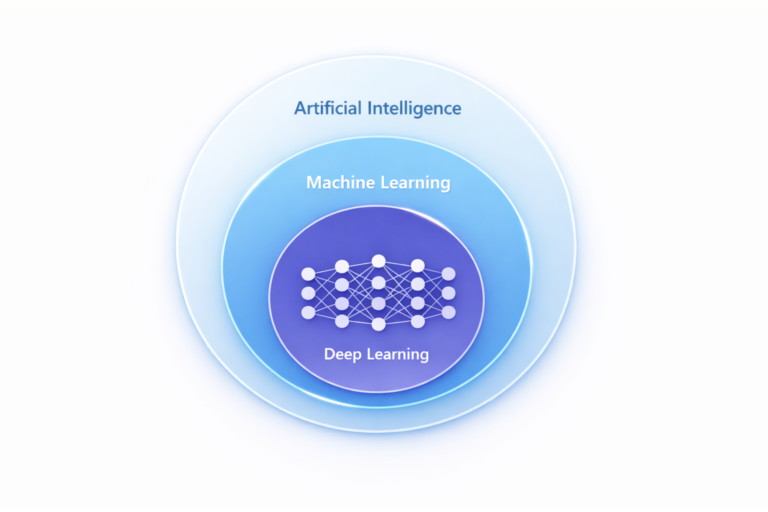
No. Machine learning is a subset of artificial intelligence. AI is the broader goal of building intelligent systems. ML is one way to achieve that.
2. Do I need advanced math to learn machine learning?
You need basic linear algebra, probability, and calculus. But you can start building practical models before mastering all theory.
3. How long does it take to learn machine learning?
Foundations: 3–6 months
Practical fluency: 1–2 years of consistent project work.
4. Is machine learning only for big tech companies?
No. Startups, hospitals, banks, and even small e-commerce stores use ML today.
5. What is the best way to understand what is machine learning deeply?
Build something.
A spam classifier.
A stock predictor.
A recommendation engine.
Theory becomes real when you see predictions change after tuning features.
That’s when machine learning stops being abstract — and starts being powerful.