
Table of Contents
Artificial Intelligence, often called AI, is one of the most talked-about technologies today. From smartphones and search engines to self-driving cars and smart assistants, AI is quietly working behind the scenes of our daily lives. Yet for many beginners, the concept still feels complex or confusing.
So, what is artificial intelligence, and why is it becoming so important in today’s digital world?
This guide explains what artificial intelligence is, how it works, where it came from, and why it matters — all in simple, easy-to-understand language, without technical jargon.
What Is Artificial Intelligence?
Artificial Intelligence (AI) refers to the ability of machines or computer systems to perform tasks that normally require human intelligence.
According to IBM’s explanation of artificial intelligence, AI refers to computer systems that can perform tasks that typically require human intelligence.
In simple terms, AI allows machines to think, learn, and make decisions in a way that imitates human behavior.
These tasks include:
- Understanding language
- Recognizing images or faces
- Solving problems
- Learning from experience
- Making predictions or recommendations
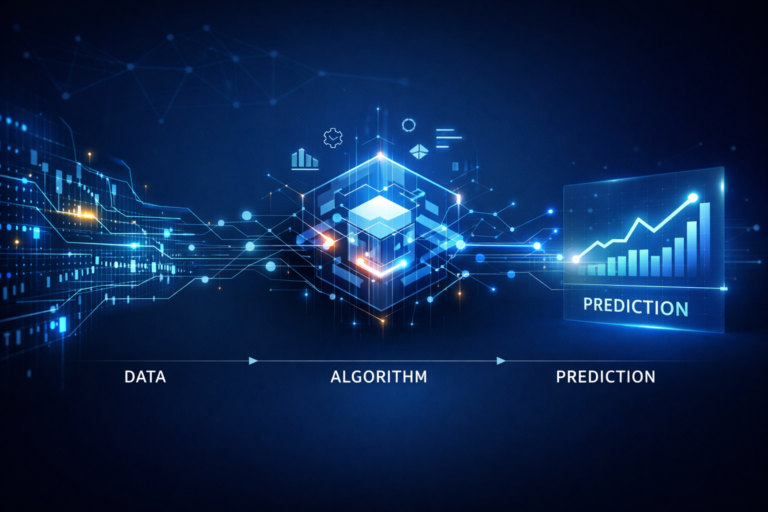
To understand what is artificial intelligence, it helps to see how machines learn from data and make decisions.
Unlike traditional software that follows fixed instructions, AI systems can improve over time based on data and experience.
A Brief History of Artificial Intelligence
AI may feel like a modern invention, but its roots go back several decades.
Early Ideas (1950s–1970s)
- In 1950, mathematician Alan Turing asked a famous question: “Can machines think?”
- The term Artificial Intelligence was officially introduced in 1956.
- Early AI systems were rule-based and limited by computing power.
AI Winters (1980s–1990s)
- Expectations grew faster than technology.
- Funding and interest declined during periods known as AI winters.
Modern AI Boom (2000s–Present)
- Massive data availability
- Faster computers and cloud computing
- Breakthroughs in machine learning and deep learning
These factors led to the powerful AI tools we use today.
How Does Artificial Intelligence Work?
At its core, AI works by learning patterns from data and using those patterns to make decisions.
Many beginners confuse AI with machine learning, but there are important differences, which we explain in our guide on AI vs machine learning.
Here’s a simplified breakdown:
1. Data Collection
AI systems need large amounts of data — text, images, videos, numbers, or user behavior.
2. Training the Model
The system analyzes the data to identify patterns.
For example, it learns what makes an email spam or what a cat looks like in an image.
3. Decision Making
Once trained, AI can:
- Answer questions
- Predict outcomes
- Recommend actions
- Recognize objects or speech
4. Continuous Learning
Advanced AI systems improve over time as they receive more data and feedback.
Types of Artificial Intelligence
Narrow AI (Weak AI)
This is the most common form of AI today. It is designed for specific tasks.
Examples:
- Google Search
- Voice assistants like Alexa or Siri
- Recommendation systems on Netflix or YouTube
General AI (Strong AI)
This type would think and reason like a human across many tasks.
It does not exist yet, but it is an active research area.
Super AI (Theoretical)
A future concept where AI surpasses human intelligence in all fields.
This remains speculative and is often discussed in ethics and research circles.
Real-Life Examples of AI Around You
AI is already part of your everyday life, even if you don’t notice it.
Smartphones
- Face unlock
- Predictive text
- Camera enhancements
Internet & Social Media
- Content recommendations
- Targeted ads
- Spam detection
Healthcare
- Disease detection from scans
- Drug discovery
- Virtual health assistants
Transportation
- GPS traffic prediction
- Ride-sharing apps
- Self-driving vehicle research
Finance
- Fraud detection
- Credit scoring
- Algorithmic trading
Artificial Intelligence vs Machine Learning
Many beginners confuse these two terms.
- Artificial Intelligence is the broader concept of machines acting intelligently.
- Machine Learning (ML) is a subset of AI that allows systems to learn from data without being explicitly programmed.
In short:
All machine learning is AI, but not all AI is machine learning.
Common Myths About Artificial Intelligence
Myth 1: AI Will Replace All Jobs
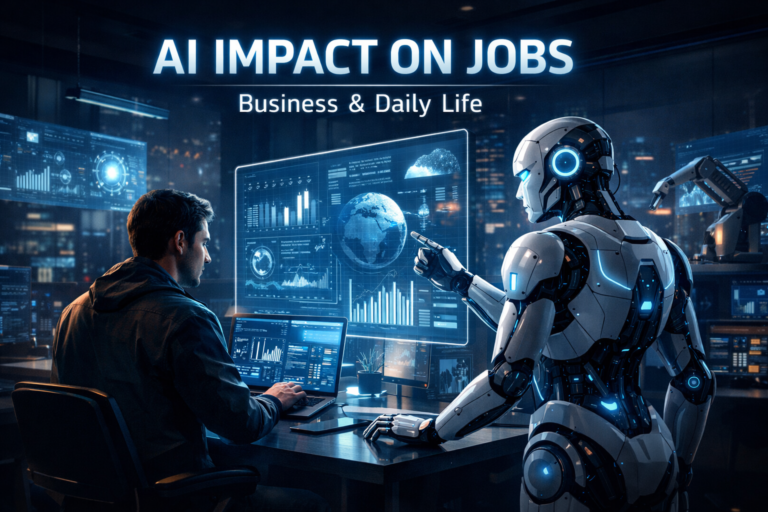
Reality: AI will change jobs, not eliminate all of them. Many roles will evolve rather than disappear.
Myth 2: AI Thinks Like Humans
Reality: AI does not have emotions, consciousness, or understanding. It processes data mathematically.
Myth 3: AI Is Always Accurate
Reality: AI depends on data quality. Poor or biased data leads to poor results.
Myth 4: AI Is Only for Big Tech Companies
Reality: Small businesses, creators, and individuals use AI tools daily.
Benefits of Artificial Intelligence
- Faster decision-making
- Improved accuracy
- Automation of repetitive tasks
- Enhanced customer experiences
- Data-driven insights
When used responsibly, AI helps humans work smarter, not harder.
Risks and Ethical Concerns
Like any powerful technology, AI comes with challenges:
- Data privacy issues
- Algorithmic bias
- Job displacement concerns
- Misuse in surveillance or misinformation
This is why ethical AI development and transparent policies are crucial.
The Future of Artificial Intelligence
The future of AI looks promising and transformative.
Leading institutions like Stanford University’s AI research division highlight how artificial intelligence continues to evolve through data, algorithms, and computing power.
Expected trends include:
- More personalized digital experiences
- Smarter healthcare diagnostics
- AI-powered education tools
- Better climate and environmental modeling
- Increased collaboration between humans and AI
Rather than replacing humans, AI is expected to become a powerful assistant across industries.
Should Beginners Learn Artificial Intelligence?
Absolutely.
You don’t need advanced math or coding skills to start. Many beginner-friendly paths exist:
- Understanding AI concepts
- Learning how AI tools work
- Using AI responsibly in daily life or business
AI literacy is quickly becoming as important as digital literacy.
Conclusion
Artificial Intelligence is not science fiction — it is a practical technology shaping the modern world. By understanding what AI is, how it works, and where it’s used, beginners can remove fear and confusion around the topic.
AI is best seen as a tool — one that amplifies human potential when used wisely.
If you’re curious about technology, the future, or problem-solving, learning about artificial intelligence is a smart place to start.