
Table of Contents
AI vs machine learning vs deep learning is one of the most confusing comparisons in modern tech. These terms are often used interchangeably in articles, job descriptions, and marketing campaigns—yet they represent very different ideas.
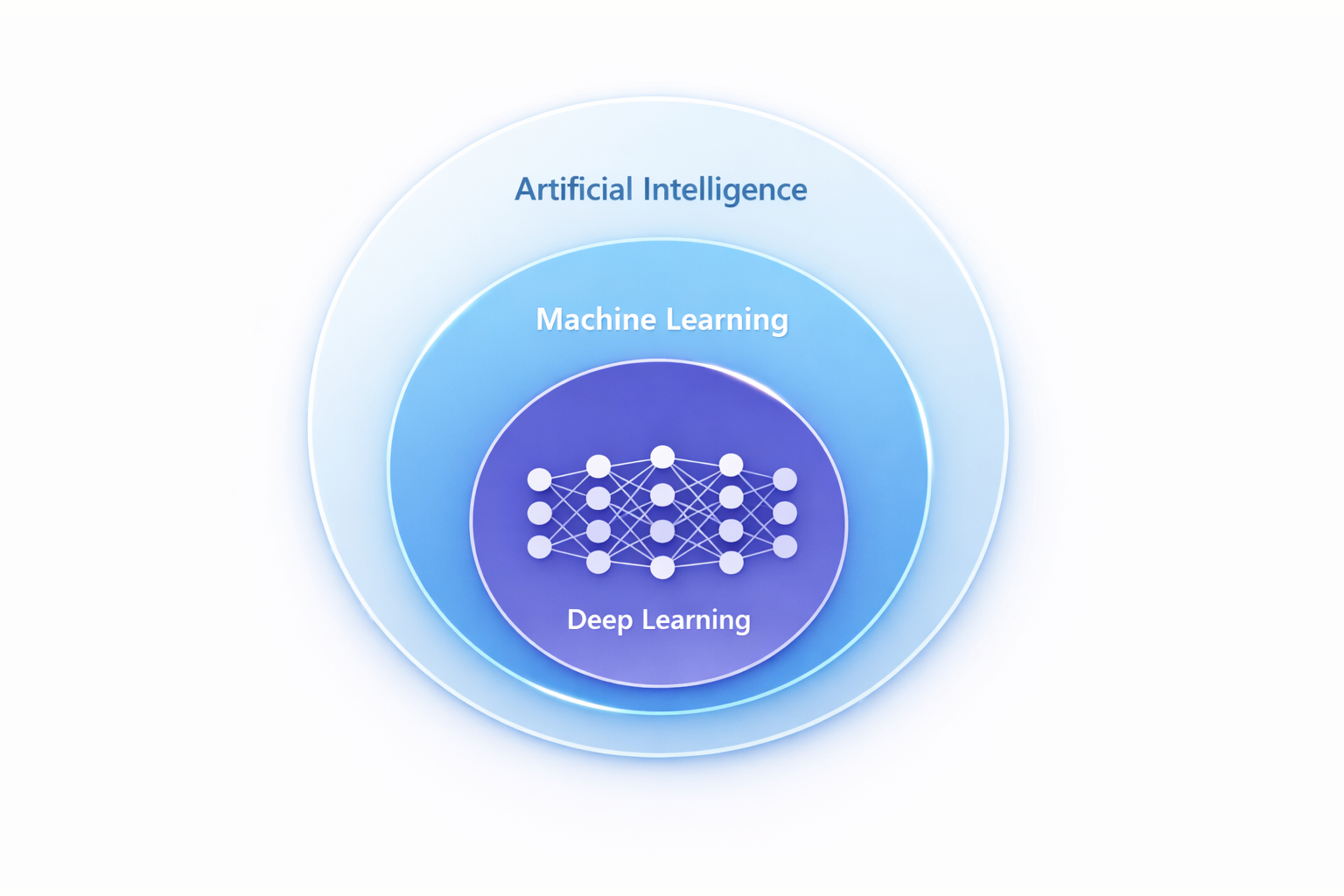
When discussing AI vs machine learning vs deep learning, it’s important to understand that these terms describe a hierarchy of intelligence rather than separate technologies competing with each other.
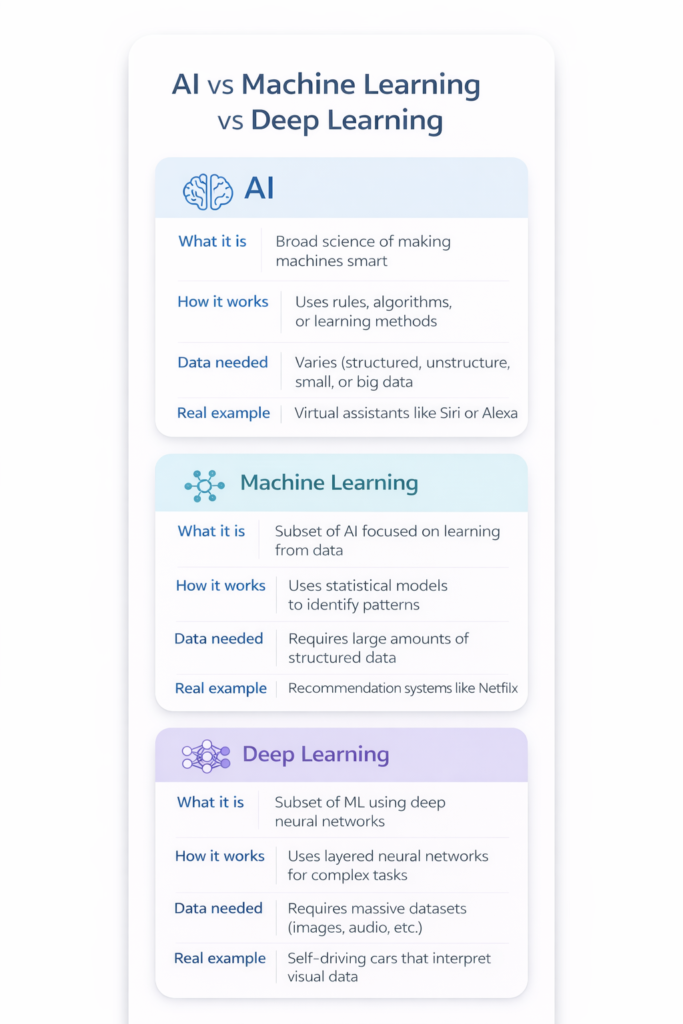
For beginners, this confusion creates barriers. For professionals, it leads to poor design decisions. The reality is simpler: AI, Machine Learning, and Deep Learning are layers of the same concept, not competing technologies.
In this article, we’ll break down:
- What Artificial Intelligence actually means
- How Machine Learning fits inside AI
- Why Deep Learning is a specialized subset of ML
- Real-world examples
- When to use each approach—and when not to
Let’s backtrack and clarify this properly.
What Is Artificial Intelligence (AI)?
Artificial Intelligence is the broad goal:
Creating machines that can perform tasks requiring human intelligence.
AI is about behavior, not techniques.
If a system can:
- Make decisions
- Solve problems
- Understand language
- Plan actions
- Adapt to situations
…it falls under AI, regardless of how it’s built.
Key idea:
AI does not require learning.
Early AI systems were entirely rule-based.
Examples of AI (without Machine Learning):
- A chess engine using predefined rules
- An expert system for medical diagnosis (if-then logic)
- A navigation system following fixed heuristics
- Game bots using scripted behavior
These systems don’t “learn.” They execute intelligence designed by humans.
That’s why AI is best thought of as the umbrella term.
What Is Machine Learning (ML)?
Machine Learning is a subset of AI.
Instead of programming rules explicitly, we allow systems to learn patterns from data.
For a practical, beginner-friendly introduction, Google’s machine learning basics course explains core concepts with real examples.
Simple definition:
Machine Learning enables systems to improve performance through experience (data).
Here, intelligence emerges from examples, not instructions.
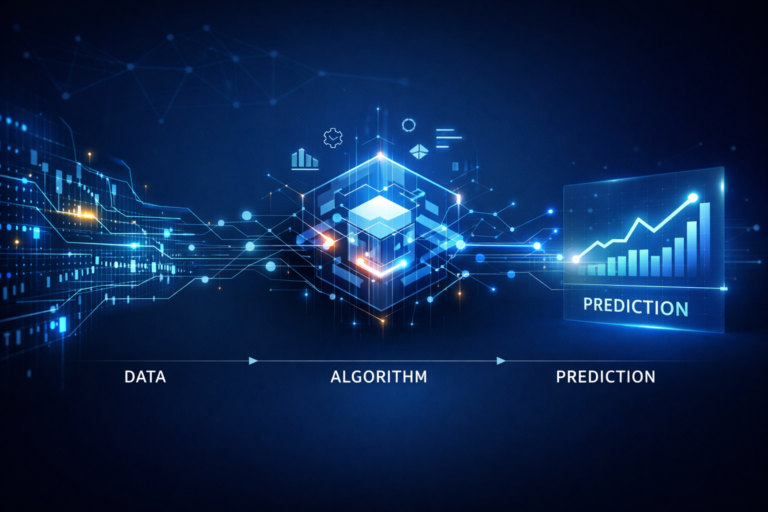
How ML works (at a high level):
- Feed data into an algorithm
- The algorithm finds patterns
- The model makes predictions or decisions
- Feedback improves future results
This shift—from rules to data—is what made modern AI powerful.
Common Machine Learning examples:
- Email spam detection
- Product recommendations
- Credit scoring
- Fraud detection
- Predictive analytics
Unlike traditional AI, ML systems change over time as data grows.
Types of Machine Learning (Quick Context)
You’ll often hear ML broken into categories:
- Supervised Learning – learns from labeled data
(e.g., email marked spam or not spam) - Unsupervised Learning – finds hidden patterns
(e.g., customer segmentation) - Reinforcement Learning – learns through reward and punishment
(e.g., game-playing agents)
Deep Learning belongs inside this ecosystem.
What Is Deep Learning?
Deep Learning is a specialized subset of Machine Learning.
It uses artificial neural networks with many layers—hence the word deep.
Core idea:
Deep Learning mimics how the human brain processes information, using layered representations.
Instead of manually selecting features, deep learning models discover features automatically.
Why this matters:
Traditional ML often requires:
- Manual feature engineering
- Domain expertise
- Clean, structured data
Deep Learning thrives on:
- Large datasets
- Complex patterns
- Unstructured data (images, audio, text)
Where Deep Learning Excels
Deep Learning powers most of what feels like “real AI” today:
- Image recognition (faces, objects)
- Speech recognition
- Language translation
- Chatbots and large language models
- Self-driving perception systems
- Medical imaging analysis
If you hear about AI that “understands” images, language, or voice—it’s almost always deep learning underneath.
AI vs Machine Learning vs Deep Learning (Key Differences)
| Aspect | Artificial Intelligence | Machine Learning | Deep Learning |
|---|---|---|---|
| Scope | Broad concept | Subset of AI | Subset of ML |
| Focus | Intelligent behavior | Learning from data | Learning via neural networks |
| Data dependency | Optional | Required | Large amounts required |
| Rule-based possible | Yes | No | No |
| Feature engineering | Manual | Often manual | Automatic |
| Compute needs | Low to moderate | Moderate | High (GPUs/TPUs) |
| Best for | Logic, planning | Predictions, patterns | Vision, language, speech |
The confusion around AI vs machine learning vs deep learning usually comes from ignoring how scope, learning capability, and data requirements differ at each level.
Think of it like this:
AI is the goal.
ML is one way to reach it.
Deep Learning is a powerful engine within ML.
Real-World Example: Email Spam Detection
Let’s compare all three using the same problem.
AI (Rule-Based)
- If email contains “free money” → mark spam
- If sender is unknown → increase spam score
Works, but breaks easily.
Machine Learning
- Learns from thousands of labeled emails
- Detects statistical patterns
- Adapts over time
More accurate, less brittle.
Deep Learning
- Understands sentence structure
- Detects intent and context
- Handles obfuscated spam
Most modern email systems combine ML and deep learning.
Another Example: Self-Driving Cars
- AI defines the goal: drive safely and autonomously
- Machine Learning predicts obstacles and behavior
- Deep Learning processes camera images, radar, and LIDAR data
None of these work alone. They stack.
When Should You Use AI, ML, or Deep Learning?
Use traditional AI when:
- Rules are clear
- Data is limited
- Interpretability matters
- Systems must be deterministic
Example: business rule engines, scheduling systems
Use Machine Learning when:
- You have structured data
- Patterns exist but rules are unclear
- Predictions improve decisions
Example: churn prediction, demand forecasting
Use Deep Learning when:
- Data is large and complex
- Inputs are images, audio, or text
- Accuracy matters more than interpretability
Example: speech assistants, medical imaging, NLP models
The Backtracking Perspective
AI progress doesn’t come from chasing buzzwords.
It comes from:
- Understanding fundamentals
- Choosing the right tool
- Correcting assumptions
- Optimizing systems step by step
AI → ML → Deep Learning is not a race.
It’s a design decision.
Final Takeaway
If there’s one thing to remember:
All deep learning is machine learning.
All machine learning is AI.
But not all AI learns—and not all learning is deep.
Once this hierarchy clicks, the confusion disappears.
Once you clearly understand AI vs machine learning vs deep learning, choosing the right approach becomes a practical engineering decision instead of a buzzword-driven one.
That clarity is what builds real systems—and real expertise.