

Table of Contents
Generative AI is everywhere in 2026.
It writes emails.
It creates images.
It builds code.
It even generates music and videos.
If you’re searching for generative AI explained in simple terms, this guide breaks it down step-by-step. Instead of technical jargon, we’ll look at how generative AI works, why it matters, and real examples you can understand immediately.
But what is generative AI really? And how is it different from traditional AI?
Before we go deeper, it helps to understand the broader foundation of artificial intelligence itself. If you’re completely new, you may want to first read our guide on What is AI? to understand the fundamentals.
In this practical beginner’s guide, we’ll break down:
- Generative AI explained in simple terms
- How generative AI works
- Real generative AI examples
- Gen AI vs AI (what’s the difference?)
- Tools you can try today
- Limitations and future direction
Let’s build this from first principles.
What is Generative AI?
Generative AI is a type of artificial intelligence that creates new content.
Generative AI explained simply: it is a branch of artificial intelligence that creates new content instead of just analyzing existing data.
Traditional AI systems are designed to detect patterns, classify information, or make predictions. Generative AI goes a step further — it produces entirely new outputs based on what it has learned.
Instead of only recognizing a cat in an image, generative AI can create a brand-new image of a cat that never existed before.
Unlike traditional AI systems that analyze or classify existing data, generative AI produces:
- Text
- Images
- Audio
- Video
- Code
- Designs
In simple words:
Traditional AI analyzes.
Generative AI creates.
If you’re new to the broader concept, you may want to first understand what AI is in general before diving deeper into generative systems.
What Can Generative AI Create?
Generative AI models can produce:
- Text (articles, emails, summaries, stories)
- Images (art, product mockups, thumbnails)
- Audio (music, voice synthesis)
- Video (AI-generated clips and animations)
- Code (functions, scripts, full applications)
- Designs (UI layouts, branding assets)
For example, research organizations like OpenAI have developed large generative models capable of producing human-like text and images. Similarly, Google has advanced generative AI systems integrated into productivity and search tools.
If you want a broader economic perspective, analysis from McKinsey & Company highlights how generative AI could significantly impact industries ranging from marketing to software development.
Generative AI vs AI: What’s the Difference?
Many beginners confuse AI with generative AI. They are related — but not the same.
Traditional AI
- Detects spam emails
- Recommends products
- Recognizes faces
- Predicts stock patterns
It focuses on classification, prediction, and automation.
Generative AI
- Writes blog posts
- Creates realistic images
- Generates product descriptions
- Builds chat responses
- Creates music compositions
It focuses on content generation.
So when people ask “gen AI vs AI”, the answer is simple:
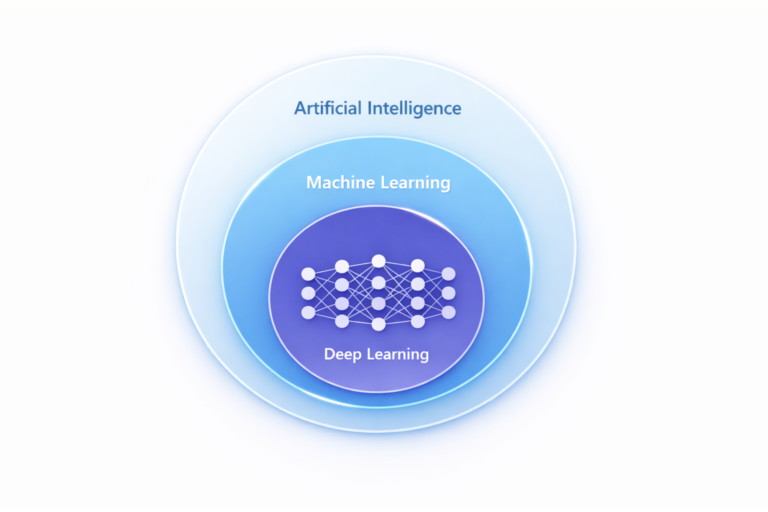
Generative AI is a subset of AI focused specifically on creation.
How Generative AI Works — Generative AI Explained Step-by-Step
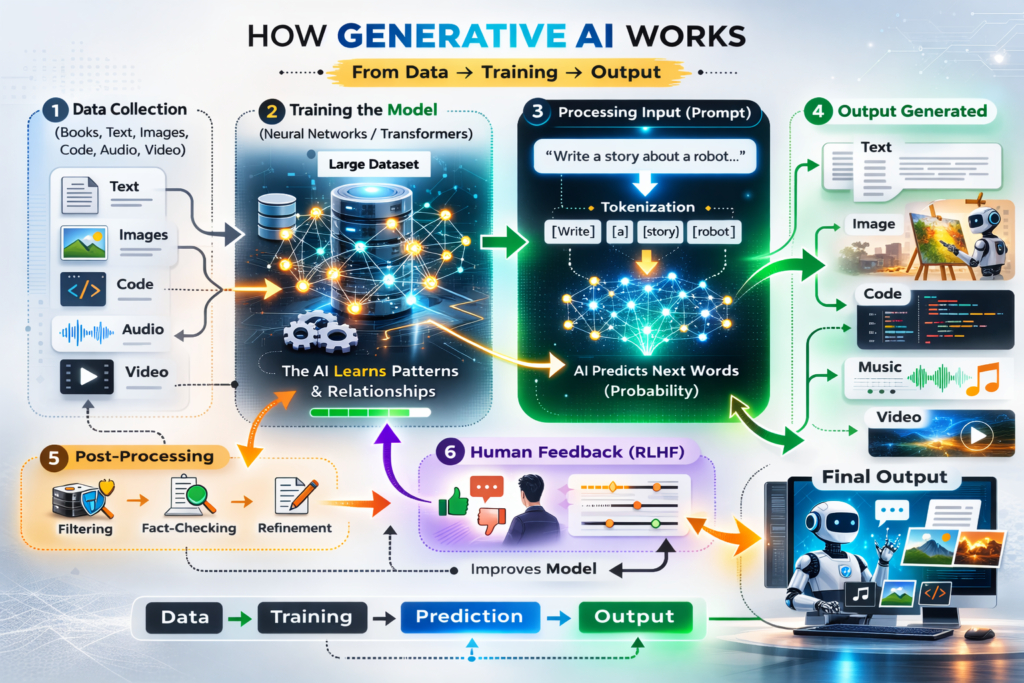
Let’s simplify how generative AI works into 4 steps.
1. Training on Massive Data
Generative AI models are trained on enormous datasets:
- Books
- Websites
- Articles
- Code repositories
- Images
For example, models developed by OpenAI are trained on diverse internet-scale data.
The model learns patterns — not by memorizing, but by identifying relationships between words, pixels, or sounds.
2. Pattern Recognition Through Neural Networks
Most modern generative AI systems use deep neural networks — especially transformer architectures.
These models learn:
- Word relationships
- Sentence structures
- Context meaning
- Visual composition
- Programming logic
They don’t “think” like humans.
They predict what should come next based on probability.
3. Prompt → Prediction → Output
When you type:
“Write a story about a robot learning emotions.”
The AI:
- Breaks your prompt into tokens
- Predicts the most likely next word
- Repeats this process thousands of times per second
The result feels intelligent — but it’s advanced statistical prediction.
4. Continuous Refinement
Modern generative models improve through:
- Reinforcement learning
- Human feedback
- Fine-tuning
This makes outputs more aligned, useful, and safe.
Real Generative AI Examples (2026)
Generative AI is not futuristic anymore. It’s already embedded into daily workflows.
Here are practical generative AI examples:
1. AI Writing Assistants
Tools like:
- OpenAI models (ChatGPT)
- Anthropic (Claude)
- Google (Gemini)
Help with:
- Blog writing
- Email drafting
- Research summaries
- Idea generation
2. AI Image Generators
- OpenAI (DALL·E)
- Midjourney
These tools create:
- Product mockups
- Thumbnails
- Concept art
- Branding visuals
3. AI Code Generators
Developers use:
- GitHub Copilot
- AI coding assistants
These tools:
- Suggest code completions
- Debug errors
- Generate entire functions
4. AI in Business & Research
According to insights from McKinsey & Company, generative AI is transforming:
- Marketing automation
- Customer support
- Drug discovery
- Financial analysis
- Enterprise workflows
This is not hype — it’s operational transformation.
Why Generative AI Matters in 2026
Generative AI is becoming a productivity multiplier.
It doesn’t replace human thinking.
It accelerates it.
The real shift is:
Human + AI collaboration.
Professionals who learn how to prompt, refine, and guide AI systems will outperform those who ignore them.
In creative industries, AI becomes:
- A brainstorming partner
- A rapid prototype engine
- A research assistant
- A content accelerator
This is foundational knowledge — not optional skill.
Tools You Can Try Today
If you’re just starting, experiment with:
- Text generation tools
- Image creation platforms
- AI design assistants
- AI coding tools
Start small:
- Generate summaries
- Create simple visuals
- Rewrite your notes
- Automate repetitive drafts
Learning happens by doing.
Limitations of Generative AI
Despite the hype, generative AI has serious limitations.
1. Hallucinations
It can confidently generate incorrect information.
2. Bias
If training data contains bias, outputs can reflect it.
3. No True Understanding
It predicts patterns — it doesn’t possess consciousness.
4. Data Dependency
Quality depends heavily on training data.
Generative AI is powerful — but it is not magic.
The Future of Generative AI
The next wave includes:
- Multimodal AI (text + image + audio combined)
- Personalized AI agents
- Autonomous workflow systems
- AI-native businesses
We’re moving from:
AI as tool → AI as collaborator → AI as infrastructure.
And understanding generative AI today gives you a long-term edge.
Final Thoughts: Generative AI Explained Simply
Now you have generative AI explained clearly and practically, without hype or unnecessary complexity.
Let’s summarize:
- Generative AI creates new content.
- It works by predicting patterns learned from massive data.
- It powers tools that write, design, code, and generate media.
- It has limitations — but massive potential.
- It’s reshaping work in 2026 and beyond.
If you’re serious about AI, this is a foundational concept that compounds over time.
The future isn’t humans vs AI.
It’s humans who understand AI.
FAQs
Is generative AI the same as AI?
No. Generative AI is a subset of AI focused on creating new content.
How does generative AI work in simple terms?
It predicts the next word, pixel, or data point based on patterns learned from large datasets.
What are examples of generative AI?
Chatbots, AI art generators, code assistants, and music generators.
Can generative AI be explained without technical background?
Yes. This guide provides generative AI explained in simple language so beginners can understand how it works and where it’s used.
Is generative AI replacing jobs?
It’s transforming jobs — not simply replacing them. The advantage goes to those who adapt.