
Table of Contents
Artificial Intelligence is no longer a futuristic concept. It’s here—quietly reshaping how we work, how companies operate, and even how we live day-to-day.
From AI writing emails and analyzing data to recommending what you watch or buy, its influence is everywhere. But this transformation is deeper than convenience. It’s redefining entire industries, creating new opportunities, and forcing us to rethink skills, careers, and human value in a machine-augmented world.
This article explores the real impact of AI on jobs, business, and daily life—without hype or fear. Just reality.
If you’re new to artificial intelligence, read our complete beginner guide:
What Is Artificial Intelligence?
Why the AI Impact on Jobs Is Accelerating in 2026
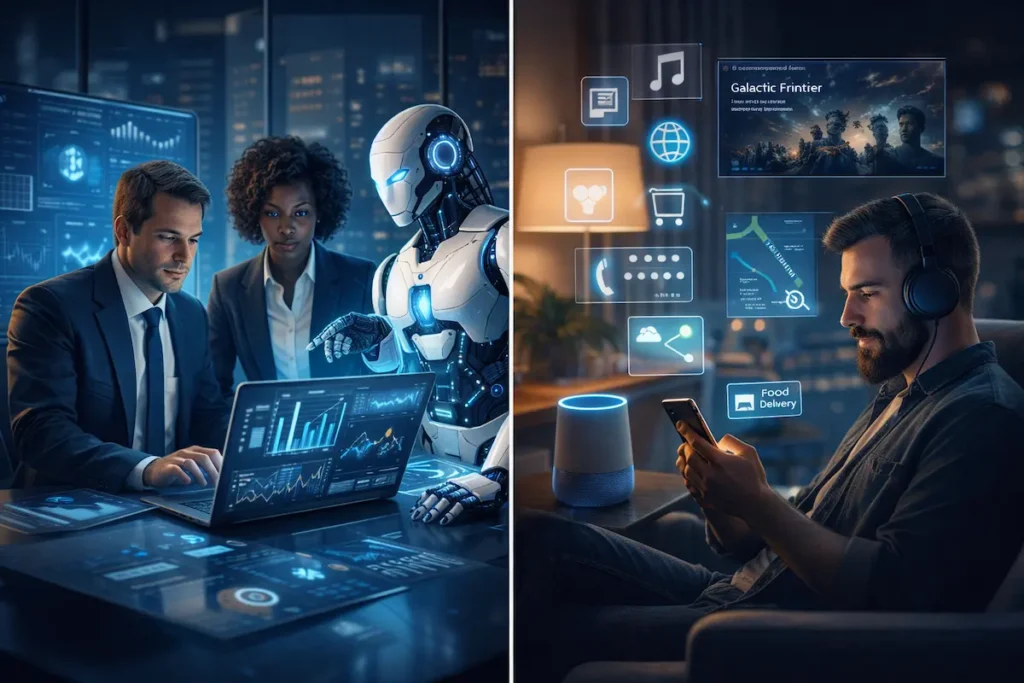
Artificial intelligence adoption has accelerated dramatically in recent years. The AI impact on jobs is no longer theoretical—companies are actively integrating AI into daily workflows. Organizations are using AI to improve productivity, reduce repetitive work, and empower employees to focus on higher-value tasks. This shift is redefining what work looks like across industries.
Previous technological revolutions automated physical labor. AI is different because it automates cognitive tasks—things once considered uniquely human.
AI can now:
- Write reports
- Analyze legal documents
- Generate software code
- Diagnose diseases
- Create art and music
Organizations like World Economic Forum estimate that AI will create millions of new jobs—but also replace many existing ones.
The key shift isn’t job destruction. It’s job transformation.
AI Impact on Jobs: Automation and Augmentation
1. Jobs That AI Is Already Changing
AI is transforming roles across industries—not just tech.
Customer Support
Chatbots now handle common queries instantly. Companies use AI to:
- Answer FAQs
- Process refunds
- Route complex cases to humans
Humans now focus on complex, emotional, or high-value interactions.
Software Development
Tools powered by organizations like OpenAI and Microsoft help developers:
- Write code faster
- Detect bugs
- Suggest improvements
This doesn’t replace developers—it makes them more productive.
Data Analysis
AI can analyze millions of records in seconds.
Tasks that took days now take minutes.
Data analysts shift from manual analysis to interpreting results and making decisions.
Content Creation
AI helps create:
- Draft articles
- Marketing copy
- Social media posts
But human creativity, storytelling, and originality remain critical.
AI becomes a tool—not a replacement.
2. Jobs That Are Growing Because of AI
AI creates entirely new career paths.
Examples include:
- AI Engineers
- Machine Learning Specialists
- Prompt Engineers
- AI Ethics Consultants
- Automation Specialists
These jobs didn’t exist 10 years ago.
Every technological shift creates new roles. AI is no different.
3. Jobs Most Likely to Be Automated
AI excels at tasks that are:
- Repetitive
- Predictable
- Data-driven
Examples include:
- Basic data entry
- Routine customer service
- Simple accounting tasks
- Basic report generation
But even here, humans supervise and manage systems.
AI replaces tasks—not entire humans.
The Real Shift: Human + AI Collaboration
For years, the dominant narrative around artificial intelligence has been conflict: humans versus machines. Headlines often frame AI as a competitor—something that replaces people, eliminates jobs, and removes the human element from work. But this framing misses the deeper reality.
The true transformation isn’t about replacement. It’s about collaboration.
The future belongs to professionals who understand how to work alongside AI, not those who try to compete with it.
The Rise of Augmented Professionals
We are entering the era of the “augmented professional.”
These are individuals who use AI as an extension of their abilities.
They don’t rely on AI blindly. They guide it.
They know:
- When to use AI
- When to question AI
- When human judgment is essential
This ability creates a significant competitive advantage.
Two people with the same education and experience can achieve vastly different outcomes depending on how effectively they use AI tools.
The difference is no longer just skill.
How AI Is Transforming Business
AI is fundamentally changing how companies operate.
Not gradually. Rapidly.
1. Faster Decision-Making
AI analyzes massive data instantly.
Businesses use AI to:
- Predict customer behavior
- Optimize pricing
- Forecast demand
- Detect fraud
This gives companies a massive competitive advantage.
2. Automation of Repetitive Operations
Businesses automate tasks like:
- Email responses
- Inventory management
- Scheduling
- Customer onboarding
This reduces costs and increases efficiency.
Companies like Amazon use AI heavily to optimize logistics and delivery.
3. Personalized Customer Experiences
AI enables hyper-personalization.
Examples include:
- Product recommendations
- Personalized ads
- Customized user interfaces
Platforms from Google and others use AI to tailor experiences to individual users.
This improves engagement and conversion.
4. Smarter Marketing
AI helps marketers:
- Analyze audience behavior
- Generate ad copy
- Optimize campaigns automatically
Marketing becomes data-driven rather than guess-driven.
5. Competitive Advantage and Innovation
Companies using AI effectively move faster.
They can:
- Launch products quicker
- Identify trends early
- Respond to changes faster
AI becomes a strategic advantage—not just a tool.
How AI Is Changing Daily Life
AI isn’t just transforming companies. It’s transforming everyday life.
Often invisibly.
1. Smart Assistants
Voice assistants can:
- Answer questions
- Set reminders
- Control devices
They make technology more accessible.
2. Recommendations Everywhere
AI recommends:
- Videos to watch
- Products to buy
- Music to listen to
- News to read
These recommendations are based on your behavior.
AI learns continuously.
3. Navigation and Transportation
AI powers:
- Traffic prediction
- Route optimization
- Ride-sharing systems
This saves time and improves efficiency.
4. Healthcare Improvements
AI helps doctors:
- Detect diseases early
- Analyze medical images
- Predict health risks
This improves accuracy and saves lives.
5. Education and Learning
AI enables personalized learning.
Students can:
- Learn at their own pace
- Get instant feedback
- Access AI tutors anytime
Education becomes more accessible globally.
Risks and Challenges of AI
AI brings immense benefits—but also real risks.
Understanding them is essential.
1. Job Displacement
Some roles will disappear.
But historically, technology creates more jobs than it destroys.
The challenge is transition—not elimination.
2. Skill Gap
Many workers lack AI-related skills.
This creates inequality between:
- AI-literate professionals
- Non-AI-literate professionals
Learning AI becomes essential.
3. Bias and Fairness
AI systems learn from data.
If data contains bias, AI can amplify it.
This requires careful design and oversight.
4. Privacy Concerns
AI relies heavily on data.
This raises questions about:
- Data ownership
- Surveillance
- Privacy protection
Responsible regulation is critical.
5. Over-Dependence on AI
Excessive reliance on AI can reduce human critical thinking.
AI should assist—not replace—human judgment.
Skills You Need to Survive the AI Impact on Jobs
You don’t need to become an AI engineer.
But you do need AI literacy.
Here are the most important skills:
1. AI Literacy
Understand:
- What AI can do
- What it cannot do
- How to use AI tools effectively
This is becoming a basic professional skill.
2. Critical Thinking
AI provides answers.
Humans must evaluate them.
Judgment becomes more valuable.
3. Creativity
AI can generate content.
But human originality and creativity remain unique.
Creative thinkers thrive.
4. Problem-Solving
AI helps solve problems.
But humans define the problems worth solving.
This skill remains essential.
5. Adaptability
The ability to learn new tools quickly is critical.
Technology will continue evolving.
Adaptability becomes a survival skill.
You can also explore the best AI tools professionals use today:
Best AI Tools for Productivity
The Biggest Myth: AI Will Replace Everyone
This is not true.
AI replaces tasks—not entire humans.
Consider history:
- Computers didn’t eliminate accountants
- Internet didn’t eliminate writers
- Automation didn’t eliminate manufacturing workers
Instead, roles evolved.
The same will happen with AI.
The Real Future: AI as a Human Multiplier
The most likely future is not AI replacing humans.
It’s humans becoming more capable with AI.
A single person can now:
- Write faster
- Analyze faster
- Build faster
- Learn faster
AI amplifies human capability.
This creates unprecedented opportunity.
Balanced Conclusion: Threat or Opportunity?
AI is neither purely good nor purely bad.
It is powerful.
Like any powerful tool, its impact depends on how we use it.
AI will:
- Replace some tasks
- Create new opportunities
- Transform existing roles
- Increase productivity dramatically
The professionals who succeed will not be those who avoid AI.
They will be those who learn to use it effectively.
The future belongs to those who adapt.
Not those who resist.
Final Thought
AI is not the end of human work.
It is the beginning of a new kind of work—where humans focus more on creativity, strategy, and meaning, while machines handle repetitive and computational tasks.
The question is not whether AI will change your job.
It’s how prepared you are for that change.
External Resources to Understand AI Impact on Jobs
According to the World Economic Forum Future of Jobs Report, AI is expected to create millions of new roles while transforming existing ones.
You can read the full report here:
https://www.weforum.org/reports/the-future-of-jobs-report
Another excellent resource is the Stanford AI Index Report:
https://aiindex.stanford.edu/report/