

Table of Contents
How AI learns is one of the most common questions people ask when they first encounter artificial intelligence. From recommendation systems to self-driving cars, modern AI systems improve by learning patterns from data rather than following fixed rules.
Artificial Intelligence often feels like magic. You give a system some data, and suddenly it can recognize faces, recommend movies, write text, or even drive cars. But behind the scenes, AI is not thinking or “understanding” the world like a human does. It is learning patterns from data through carefully designed mathematical processes.
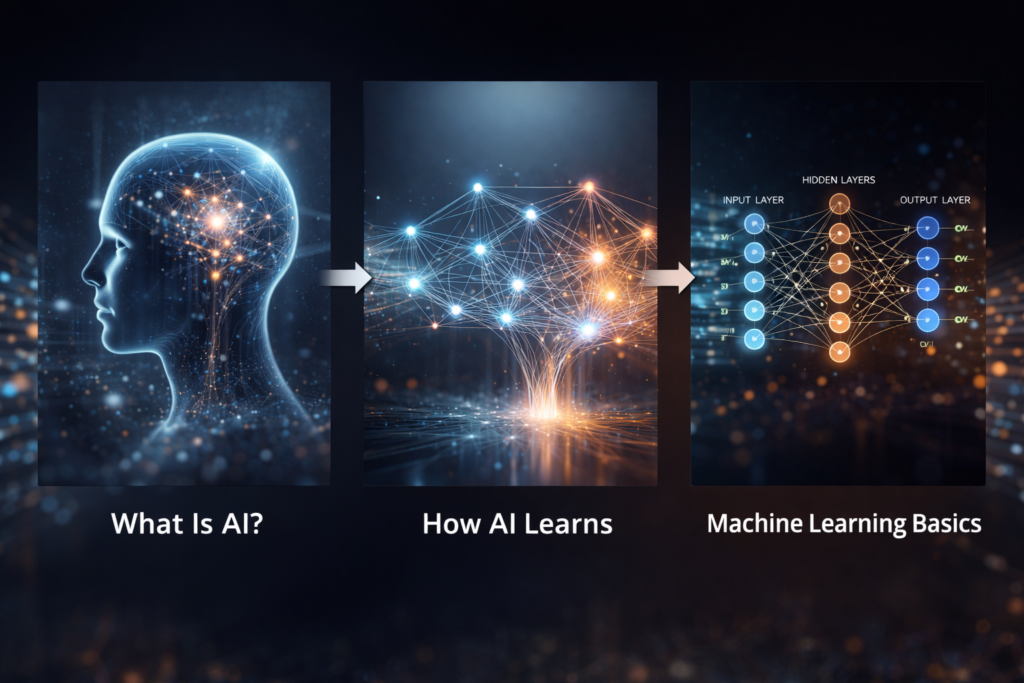
Understanding how AI learns helps beginners see why data, training, and feedback play such a critical role in building intelligent systems.
These learning methods build on the core ideas discussed in our introduction to what is AI and how intelligent systems are designed.
In this article, we’ll break down how modern AI systems learn, step by step — from raw data to intelligent behavior — in a way that’s clear, practical, and grounded in real-world examples. Whether you’re a student, educator, or curious professional, this guide will help you truly understand how machine learning works.
Introduction: What Does “Learning” Mean in AI?
When humans learn, we rely on experience, reasoning, emotions, and intuition. AI learning is different. For machines, learning means:
Adjusting internal parameters based on data so that future predictions or decisions become more accurate.
AI does not “know” things. It optimizes.
At the core of most modern AI systems is machine learning (ML) — a subset of AI that allows systems to improve performance by analyzing data rather than following hard-coded rules.
To understand how AI learns, we need to start with the most important ingredient of all.
Data in AI: The Foundation of Learning
Why Data Matters
AI systems are only as good as the data they learn from. Data is the experience of an AI system.
Examples of AI training data include:
- Images (photos, scans, satellite imagery)
- Text (articles, reviews, messages)
- Audio (speech, music, noise)
- Numbers (sensor readings, financial records)
- User behavior (clicks, likes, watch time)
Without data, AI cannot learn anything useful.
Types of Data
- Structured Data
Organized data like tables, spreadsheets, and databases
Example: customer age, salary, purchase history - Unstructured Data
Messy, real-world data like images, text, and video
Example: social media posts, medical images
Most modern AI breakthroughs come from learning on unstructured data, which is harder for traditional software to handle.
Data Quality Over Quantity
More data helps, but clean, relevant, and unbiased data matters more. Poor-quality data leads to poor learning — a principle often summarized as:
Garbage in, garbage out.
How AI Learns During the Training Process
At a high level, the AI learning process looks like this:
- Collect data
- Choose a learning method
- Train a model
- Evaluate performance
- Improve through feedback
These steps are central to understanding how AI learns from mistakes and gradually improves its predictions over time.
Let’s break this down.
Learning Methods in Machine Learning
1. Supervised Learning
In supervised learning, the AI is trained on labeled data.
- Input: data
- Output: correct answer
Example:
You show the system thousands of images of cats and dogs, each labeled correctly. The AI learns to associate visual patterns with labels.
Used in:
- Image classification
- Email spam detection
- Speech recognition
2. Unsupervised Learning
Here, data has no labels. The AI must find patterns on its own.
Example:
Grouping customers based on shopping behavior without knowing categories beforehand.
Used in:
- Clustering
- Anomaly detection
- Market segmentation
3. Reinforcement Learning
The AI learns by trial and error, guided by rewards and penalties.
Example:
A game-playing AI receives points for winning and penalties for losing. Over time, it learns strategies that maximize rewards.
Used in:
- Robotics
- Game AI
- Autonomous systems
Models: The Brain of an AI System
What Is a Model?
An AI model is a mathematical structure that maps inputs to outputs.
Think of a model as a flexible formula that changes shape as it learns.
Examples:
- Linear regression
- Decision trees
- Neural networks
- Transformers (used in modern language models)
Neural Networks Explained Simply
Neural networks are inspired by the human brain but operate very differently.
Neural networks learn by adjusting weights during training, a concept explained clearly in TensorFlow’s learning resources.
They consist of:
- Input layer – receives data
- Hidden layers – process patterns
- Output layer – produces predictions
Each connection has a weight (a number). Learning means adjusting these weights to reduce errors.
Training: From Guessing to Accuracy
When training starts, the model makes random guesses.
Step-by-Step Training Loop
- Forward pass
The data flows through the model, producing an output. - Loss calculation
The system measures how wrong the prediction is using a loss function. - Backpropagation
The error is sent backward through the model. - Weight update
The model adjusts its internal parameters slightly. - Repeat
This happens thousands or millions of times.
Over time, the model’s guesses become better.
This process is how machine learning works in practice.
Feedback Loops: How AI Improves Over Time
AI learning doesn’t stop after training.
Continuous Learning
Many real-world systems use feedback to improve:
- Recommendation engines adapt to user behavior
- Search engines refine results based on clicks
- Fraud detection systems learn new attack patterns
Human-in-the-Loop
In sensitive domains like healthcare or law, humans review AI outputs and provide corrections. This feedback becomes new training data.
Feedback loops are essential for:
- Reducing errors
- Handling edge cases
- Preventing performance decay
Example Walkthrough: How an AI Learns to Recognize Spam Emails
Let’s walk through a simple example.
Step 1: Data Collection
Thousands of emails labeled as “spam” or “not spam”.
Step 2: Feature Extraction
The system looks at:
- Certain keywords
- Sender reputation
- Email structure
Step 3: Training
The model learns which patterns are common in spam emails.
Step 4: Prediction
A new email arrives. The AI calculates the probability of it being spam.
Step 5: Feedback
If users mark emails incorrectly classified, the system learns from that feedback.
This same learning principle scales up to far more complex tasks.
Limitations: What AI Learning Cannot Do (Yet)
Despite impressive results, AI learning has real limitations.
1. Data Bias
If training data is biased, the AI will reflect that bias.
2. Lack of True Understanding
AI recognizes patterns, not meaning. It does not “understand” context like humans do.
3. Poor Generalization
AI struggles outside the conditions it was trained on.
4. High Data and Energy Costs
Training modern AI models requires massive datasets and computational power.
Understanding these limitations is critical for responsible AI use.
The Future of AI Learning
AI learning is evolving rapidly.
Key Trends
- Self-supervised learning
Reducing dependence on labeled data - Multimodal learning
Learning from text, images, audio, and video together - Edge learning
AI learning directly on devices, not just in the cloud - More efficient models
Smaller models with better performance
The goal is not just smarter AI, but more reliable, transparent, and energy-efficient learning systems.
Final Thoughts: From Data to Intelligence
AI learning is not magic — it’s mathematics, data, and feedback working together at scale.
To summarize:
- Data is the foundation
- Models detect patterns
- Training refines predictions
- Feedback drives improvement
- Limitations remind us AI is a tool, not a mind
When we understand how AI learns, we can use it more effectively, ethically, and creatively.
As AI continues to shape technology, education, and society, this understanding is no longer optional — it’s essential.
Once you understand how AI learns, it becomes easier to evaluate its strengths, limitations, and real-world impact.